Blog

Product Diversification in an Income Portfolio, Part 2

In Part 1, I gave an overview of product diversification in an income portfolio.  By way of illustration, I presented two extremes, where each portfolio had only one product, namely equity investments or an annuity (guaranteed income stream).

Here in Part 2, I show you what product diversification looks like (also known as “income layering”).

At the base is a fixed amount of income that may come from government pension payments such as CPP (Canada Pension Plan) and OAS (Old Age Security).  These payments remain fairly level or increase slightly with inflation.  An annuity can be from a company pension plan or through a purchase with an insurance company.  These first two layers form the foundation of your income portfolio and are usually guaranteed for life.

On top of these foundational layers are registered and non-registered savings.  Some savings are invested for long-term growth and some are deposited in guaranteed options, such as GIC’s (Guaranteed Income Certificates) or daily savings accounts.
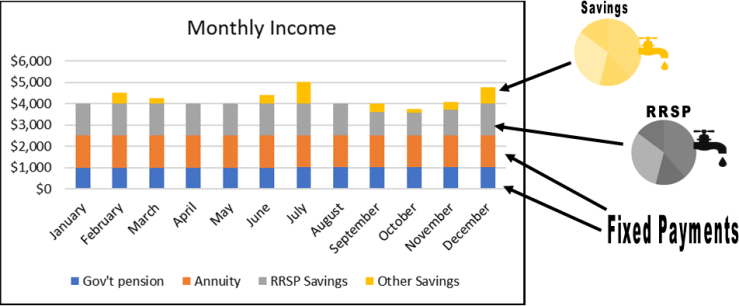
The above illustration shows that monthly income needs vary.  Other Savings are available to draw upon when needed.  As well, savings that are invested may undergo a market downturn during which time, it may be wise to decrease the flow of redemptions.

An income portfolio that has product diversification is better equipped to handle your varying financial needs throughout your retirement.


Product Diversification in an Income Portfolio, Part 1

In the world of investing, we hear of “diversification” as the key to long-term growth with minimum volatility.  When markets fluctuate – up or down – we want stocks that can capture the highs and other investments, which can hold their value during the lows.  Such a well-diversified portfolio may deliver a decent return over the long term.  And that’s what most investors want while saving for the future.

When it’s time to spend the portfolio (i.e., retirement), then “product diversification” is essential to a successful financial future.  An ideal income portfolio has guaranteed savings, a guaranteed income stream (annuity), as well as investments.  The proportions depend on your “risk” situation.  To illustrate, consider the two extremes.

1.  Retirement income that is comprised of 100% equity investments.

In such a scenario, income payments are made by selling units of the investments.  This works well in a rising market because the value of the portfolio grows and if lucky, the growth rate outpaces the redemption rate.

However, in a falling market, the value of the portfolio keeps decreasing and eventually, the payments will run out (known as sequence of returns risk).

2.  Retirement income that is comprised of 100% annuity (guaranteed income stream).

In this scenario, payments simply continue throughout retirement and are unaffected by market movements.  This arrangement offers a lot of peace of mind to the annuitant (one receiving the payments).

But there is a disadvantage of depending solely on a stream of payments for all financial matters.  Life’s expenditures are not so “even”.  It is challenging to meet large expenses and you may be forced to take on debt.  With debt, a portion of the annuity will have to be directed to the principal and interest of the debt leaving less for the annuitant’s day to day living expense.

Ideally, an income portfolio will have some guaranteed fixed income and some investment and savings.  In Part 2, I discuss what product diversification in an income portfolio looks like.

Income Portfolios and Market Volatility

graph illustration
Photo by Burak K on Pexels.com

During periods of extreme market volatility, and decline in particular, the sage advice to investors is to “hold on.”  That’s true because within a year or two, markets will recover and continue their upward path.  Getting out of your investment (i.e., selling) will have the effect of locking in the loss.  But what if you can’t hold on?  If your portfolio is your registered pension income, or will soon become one, then periodic withdrawals are going to happen regardless of market behaviour.  And avoiding the markets altogether will lead to a shorter lifespan for your pension income.

The answer is a portfolio that can do two things at once:  let you hold on to your investments during market declines but still provide income without selling any of those investments while they are down in value.  It just takes a bit of planning ahead.

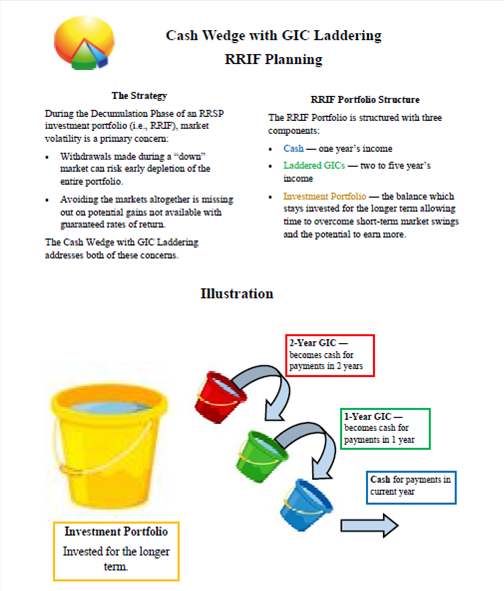
Cash WedgeThe principle behind an income portfolio that can withstand market volatility is known as the “Cash Wedge”, which includes a measure of guaranteed investment certificates (GICs) with laddered maturity dates.  Click thumbnail at right to open a pdf in new window.

The current market environment can be worrisome.  If you are a young investor with a lengthy time horizon (several years before any withdrawals), then the best thing is to not fret over the markets and ride out the volatility.

If your time horizon is much shorter (withdrawals within 3 to 5 years), then let this current market uncertainty be a signal that your portfolio may require some design changes.

Canadian Income Tax Act: Watershed Moments

photo of beige and green castle
Photo by Tetyana Kovyrina on Pexels.com

Tax on income at the Federal level began in Canada in 1917.  It was introduced as a means to fund war time spending, and as such was called the Income War Tax Act.  It was then described as a temporary measure, but as we know today, it became a permanent and important source of tax revenue thereafter.  For example, in 1917, tax on income provided approximately 2% of all federal revenue, whereas a century later, it is providing over 50% of all federal revenue.  (See Fraser Institute Infographic) What happened?  I present for you here a sampling of what I consider are watershed moments in the history of our income tax system.

1941 – Up until now, the provinces had the right to levy provincial income tax for their own spending needs.  In 1941, the provinces surrendered that right to the federal government in exchange for “rental” payments from the federal to the provinces.

1942 – Pay-as-you-earn income tax is introduced.  Employers are now required to withhold tax from employee earnings and remit these amounts to the federal government each period.

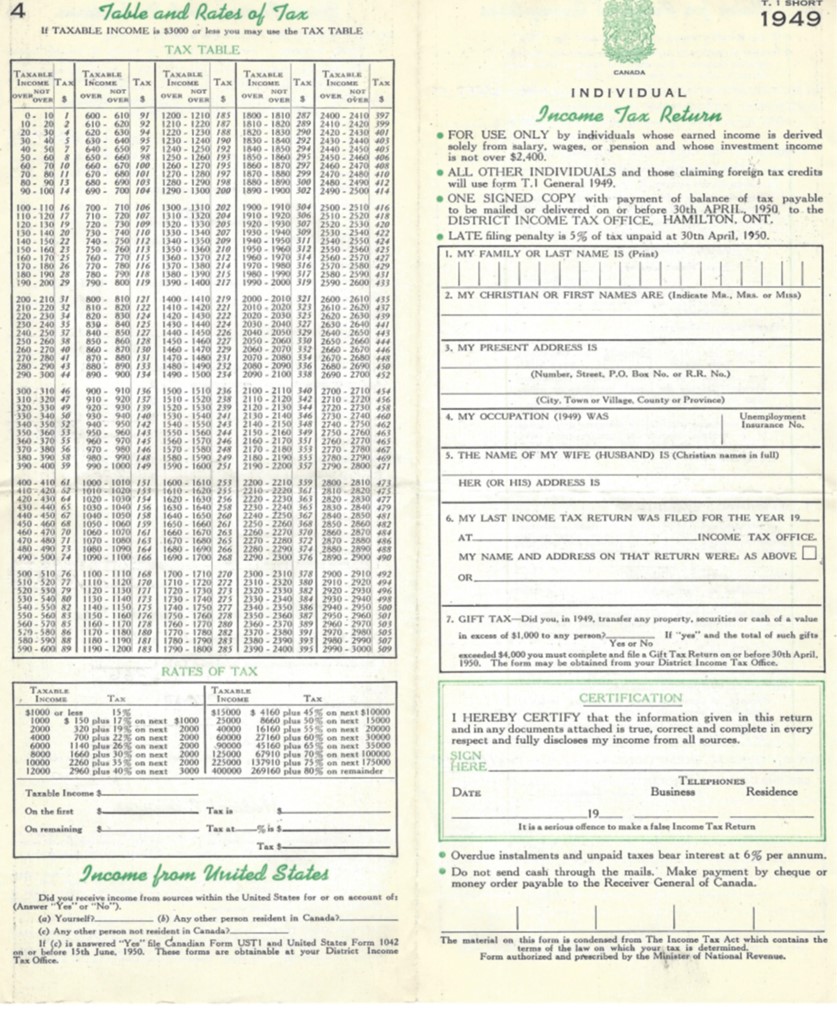
tax return 1949

(Click thumbnail to open a 1949 Income tax return in new window)

1949 – The Income War Tax Act is renamed, Income Tax Act, the first indication that income tax is no longer considered temporary.

1964 – “Social Insurance Numbers” replace “Unemployment Insurance Numbers” as the means to identify taxpayers.

1966 – Canada Pension Plan (CPP) is launched and “premiums” are added to the income tax system.  Maximum annual premium is $79.20, or 1.8% of the maximum insurable earnings of $4400.

1988 – “Personal Deductions” changes to “Non-Refundable Tax Credits”.  Instead of using these deductions to reduce your taxable income (at your highest marginal tax rate), these same deductions become credits, which can only be used to reduce your income tax at one flat tax rate (the lowest marginal tax rate).

What’s next?

2016 – New requirement to report the sale of a principal residence (your home).  Is this the precursor for a new tax?  Will there soon be tax levied on the “gain” from the sale of your home?

A government’s only source of revenue is taxation.  The bigger it grows, the more it taxes.  Watershed moments are taxation growth leaps or signals of a leap in the making.

Hiding Inflation

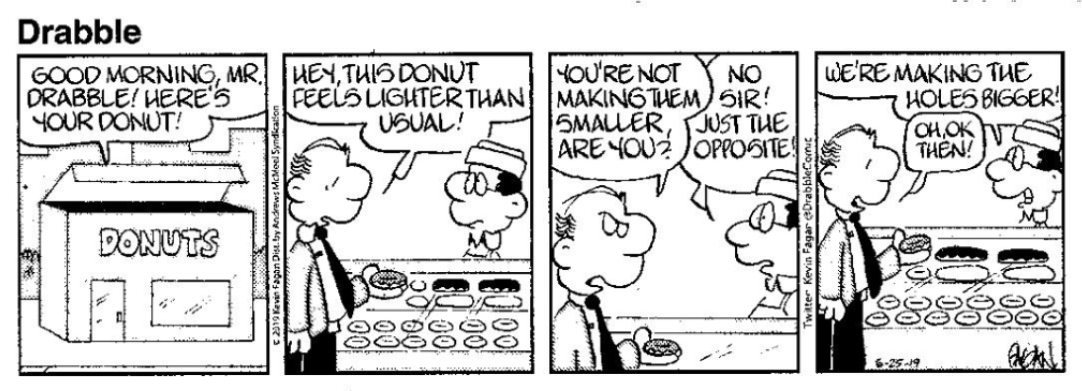
Drabble comic -donut

Inflation is the widespread increase in prices in an economy caused when a country’s money supply is increased faster than its aggregate production.  It means that *everything* costs more today than it did yesterday.

Consumers do not react well to rising prices and companies know this.  Rather than risk consumer wrath – and the loss of their patronage – companies find a way to hide the price increase.  Here’s an example:

TP -inflation-webSome years ago, Cottonelle toilet tissue re-branded their product as Cashmere.  But in doing so, the product and the packaging underwent an evolution of changes where the product shrank in size while the price remained about the same.
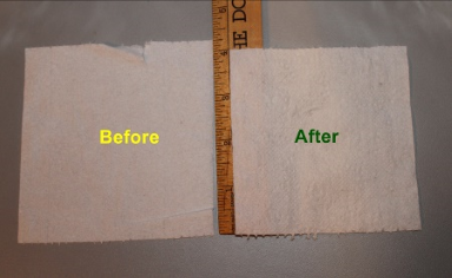
The old packaging of Cottonelle boasts jumbo-sized rolls that are 1.5 times larger than regular, with 360 sheets per roll.  Today, a package of Cashmere declares its rolls are 3 times larger than regular, with… wait for it… 363 sheets per roll.

TP -squares-webAnd that’s not all.  Even the size of an individual square has been reduced.

Cashmere is not alone using this strategy of hiding inflation.  I have noticed many products being packaged in smaller and smaller sizes or quantities.  Some examples that come to mind are cheese, cookies, and bacon.  Do you have more examples?