
Product Diversification in an Income Portfolio, Part 2

In Part 1, I gave an overview of product diversification in an income portfolio.  By way of illustration, I presented two extremes, where each portfolio had only one product, namely equity investments or an annuity (guaranteed income stream).

Here in Part 2, I show you what product diversification looks like (also known as “income layering”).

At the base is a fixed amount of income that may come from government pension payments such as CPP (Canada Pension Plan) and OAS (Old Age Security).  These payments remain fairly level or increase slightly with inflation.  An annuity can be from a company pension plan or through a purchase with an insurance company.  These first two layers form the foundation of your income portfolio and are usually guaranteed for life.

On top of these foundational layers are registered and non-registered savings.  Some savings are invested for long-term growth and some are deposited in guaranteed options, such as GIC’s (Guaranteed Income Certificates) or daily savings accounts.
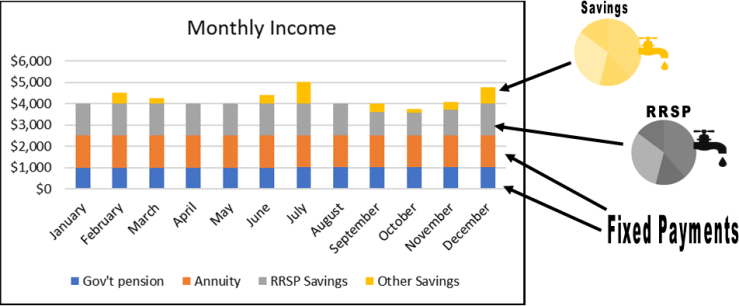
The above illustration shows that monthly income needs vary.  Other Savings are available to draw upon when needed.  As well, savings that are invested may undergo a market downturn during which time, it may be wise to decrease the flow of redemptions.

An income portfolio that has product diversification is better equipped to handle your varying financial needs throughout your retirement.

Product Diversification in an Income Portfolio, Part 1

In the world of investing, we hear of “diversification” as the key to long-term growth with minimum volatility.  When markets fluctuate – up or down – we want stocks that can capture the highs and other investments, which can hold their value during the lows.  Such a well-diversified portfolio may deliver a decent return over the long term.  And that’s what most investors want while saving for the future.

When it’s time to spend the portfolio (i.e., retirement), then “product diversification” is essential to a successful financial future.  An ideal income portfolio has guaranteed savings, a guaranteed income stream (annuity), as well as investments.  The proportions depend on your “risk” situation.  To illustrate, consider the two extremes.

1.  Retirement income that is comprised of 100% equity investments.

In such a scenario, income payments are made by selling units of the investments.  This works well in a rising market because the value of the portfolio grows and if lucky, the growth rate outpaces the redemption rate.

However, in a falling market, the value of the portfolio keeps decreasing and eventually, the payments will run out (known as sequence of returns risk).

2.  Retirement income that is comprised of 100% annuity (guaranteed income stream).

In this scenario, payments simply continue throughout retirement and are unaffected by market movements.  This arrangement offers a lot of peace of mind to the annuitant (one receiving the payments).

But there is a disadvantage of depending solely on a stream of payments for all financial matters.  Life’s expenditures are not so “even”.  It is challenging to meet large expenses and you may be forced to take on debt.  With debt, a portion of the annuity will have to be directed to the principal and interest of the debt leaving less for the annuitant’s day to day living expense.

Ideally, an income portfolio will have some guaranteed fixed income and some investment and savings.  In Part 2, I discuss what product diversification in an income portfolio looks like.